Autonomous Infrastructure Efficiency
Why Now?
Over the past couple of years, everything in AI has been moving forward at an insane pace.
Models got better + Agents became real + Software started writing software.
Infrastructure became one of the fastest-growing cost centers in every company, the rising spend on IT is accelerating, driven mainly by the fact that enterprises are reducing headcount spend and increasing AI spend (software, infra).
Companies are burning through their expected annual token budget in 4 months. One company spent 500 million dollars on Claude in 1 month.
AI agents generate workloads continuously, engineers ship far more code than before, and infrastructure scales without real constraints.
The looming issue – none of it is being built efficiently.
The Contrarian Bet on Cloud Cost
Three years ago, backing a cloud cost startup wasn’t obvious to say the least.
The domain had a negative zeitgeist due to historical medium-sized outcomes, FinOps existed, but it wasn’t core.
PointFive took a different view early on: They believed cloud cost is the wedge for building the infrastructure efficiency category (more on that below).
That bet turned out to be right and it seems AI takes that problem and makes it 10x bigger and more complex.

~2024 – Getting ready to go pitch PointFive to potential customers
What is efficiency anyway?
Builders want the best performance possible in the lowest cost possible, this is what makes a good business.
Cutting costs is one side of the equation, the other is improving performance.
Building an efficient infrastructure means optimizing, removing redundancy, wasteful components and enabling active resources to power the task which matters most to the end customer.
Important problem, large market.
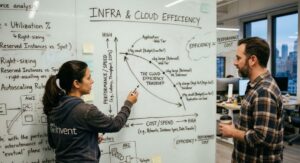
The real issue isn’t cost visibility. It’s not even (only) about automatic infra optimization.
The challenge is about empowering human and agentic engineers to act about cost, optimize resources to align with company goals and keep efficiency top of mind while running ahead as fast as possible on the roadmap.
You end up with autonomous systems creating waste, AI agents which suck up your entire token budget on some random staging environment experiment instead of where it counts.
That’s a different category. A novel category…
The Team
A few words ago we told you this was not an obvious space to bet on…However, what was obvious to us was that this is a team to bet on.
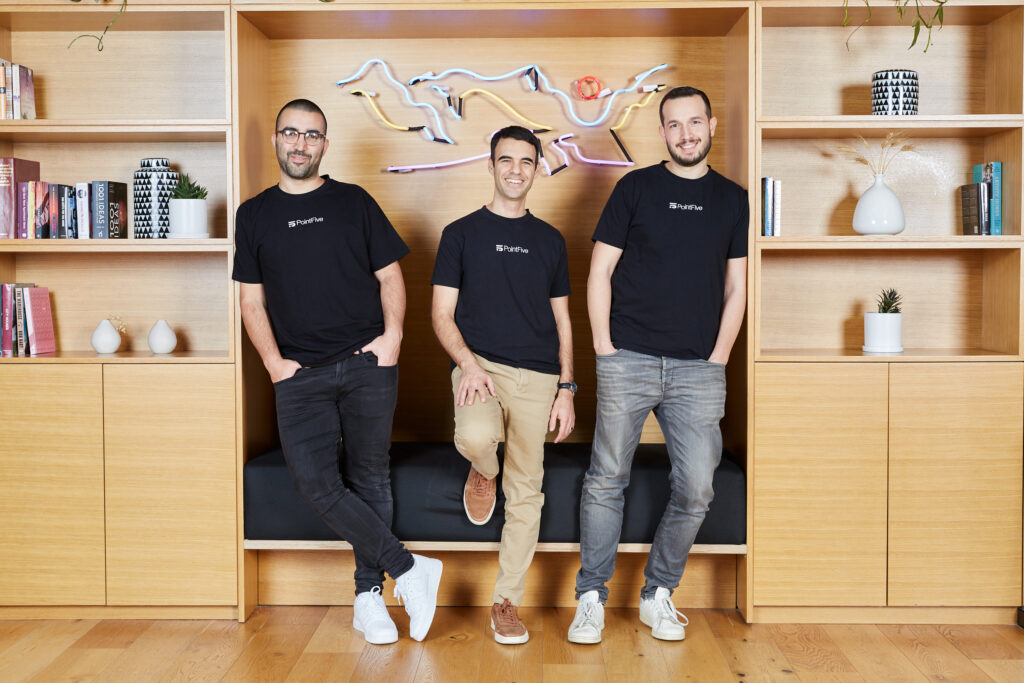
Alon, Gal and Amir built Intsights together (Acq. by Rapid7 for ~$350m) and to Alon’s words “This time we are going to go all the way.”
We knew they were smart, thoughtful and ambitious but it turned out as a delightful surprise that they also know how to hire the best talent in Israel and the US while never being content with how fast they are going.
They started with cloud waste, built a deep understanding of how infrastructure behaves in production, and earned the right to expand from there and win the soon to become $1 Trillion cloud and AI efficiency market.
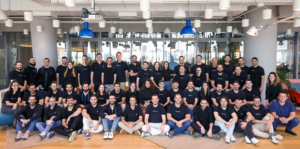
Poinfive Team. Credit: Eyal Marilus
What is it that they do?
PointFive detects root-cause waste, works agentlessly and read-only, covers cloud infrastructure, data platforms, and AI workloads, routes fixes to the engineers who own them, and supports autonomous remediation.
AI workloads are adding an entirely new layer of cost that legacy tooling was never built to see. Most tools tell teams what they spent. PointFive shows them what they are wasting and why, surfacing inefficiencies that conventional cost tooling and manual review miss entirely.
If you made it this far in this post, buckle up for the coming weeks as the team unveils a few step-function changes to their platform as well as a novel new product…
Final Thought
Every major platform shift in software creates a new tax.
Cloud created infra cost saving, AI created infra efficiency management.
Today the systems generating the problem are autonomous which means the solution has to be autonomous too.
Enter PointFive.
******************************
We’re proud to announce PointFive’s $60M Series B, led by Accel, bringing total funding to well over $100M, with participation from Entrée Capital, Vesey Ventures, and Salesforce Ventures.
Excited to welcome Philippe Botteri to the Board alongside us and Chris Degnan (ex-Snowflake CRO).
LFG!

Related Resources

The Mental Backlog
Guidde: The AI-native horizontal PLG startup that could